

The Chevy Colorado 3rd generation launched in 2023 to near-universal praise from the automotive press. The 2.7L turbocharged four-cylinder was described as a revelation. The interior was dramatically upgraded. The ZR2 was called the most capable midsize off-road truck available. Then, owners started filing Consumer Reports surveys, and the picture shifted. The 2023 Colorado rates below average reliability. The 2024 Chevy Colorado rates below average. The 2025 Chevy Colorado rates much less reliable. The 2022 Colorado, the final year of the generation everyone called outdated, rates average. Before buying any Colorado, checking the interior trim color code confirms the exact seat configuration on that specific VIN, which matters for seat cover fitment across 2nd and 3rd-gen builds.
| Year | Consumer Reports Rating | NHTSA Recalls | What Owners Actually Say |
|---|---|---|---|
| 2015-2016 (2nd gen launch) | N/A (older) | Multiple | 8-speed hunting between gears; $3,500 to $5,000 transmission replacement in worst cases |
| 2017-2022 (2nd gen mature) | Average (2022: avg.) | Low | Transmission resolved; Duramax diesel available from 2017; 2022 is the safest 2nd-gen exit |
| 2023 (3rd gen launch) | Below average | 3 recalls | Rough idle; transmission hesitation; exhaust issues; starter failure; not what launch reviews suggested |
| 2024 (3rd gen) | Below average | 3 recalls | Infotainment freezing; drivetrain leaks; engine minor issues; rough shifting in multiple owner reports |
| 2025 (3rd gen) | Much less reliable | 1 recall | Engine major and brake issues emerge; worst Consumer Reports rating of any Colorado year |
What the 2.7L Turbo Actually Looks Like After 20,000 Miles of Owner Reports
The launch reviews drove pre-production and early-build examples, and came away impressed. Owners who put real miles on 3rd-gen Colorados have reported a different experience. From Consumer Reports owner surveys and automotive forums: the 2.7L turbo idles roughly on cold starts, shifts hesitantly in ways that multiple dealers confirmed with software updates rather than dismissing, and builds carbon deposits on intake valves faster than expected for a direct-injected engine without port injection. One owner in Maine reported a starter failure at under 10,000 miles. Another in Texas noted the transmission "doesn't upshift as it should" and that the dealer confirmed it with a software patch rather than identifying a root cause.
The ZR2's drivetrain has generated forum complaints about a leaking gasket between the driveshaft and transfer case. Battery drain on parked trucks has appeared in multiple owner threads across Colorado fan communities. None of these is catastrophic. All of them are patterns. On an out-of-warranty 3rd-gen Colorado, there are repair bills that indicate what to look for when assessing a used Colorado's interior condition alongside its mechanical history, connecting both sides of the used-truck assessment accurately.
The Years That Actually Hold Up: What the 2nd Gen Got Right
“Great communication. Informative installation videos. Durable seat covers and steering wheel wrap. Nice upgrade from the flimsy, worn-out covers I had.”
“They feel super comfortable and were easy to install! Can't wait to get my custom rear seat covers!”
“There's not much to say — you simply have to buy them yourself because they truly speak for themselves. From the online purchase to the fit, top notch.”
“I couldn't have been more pleased with this product!”
“Great fit, great looks, great quality. Exactly what I wanted for my truck.”
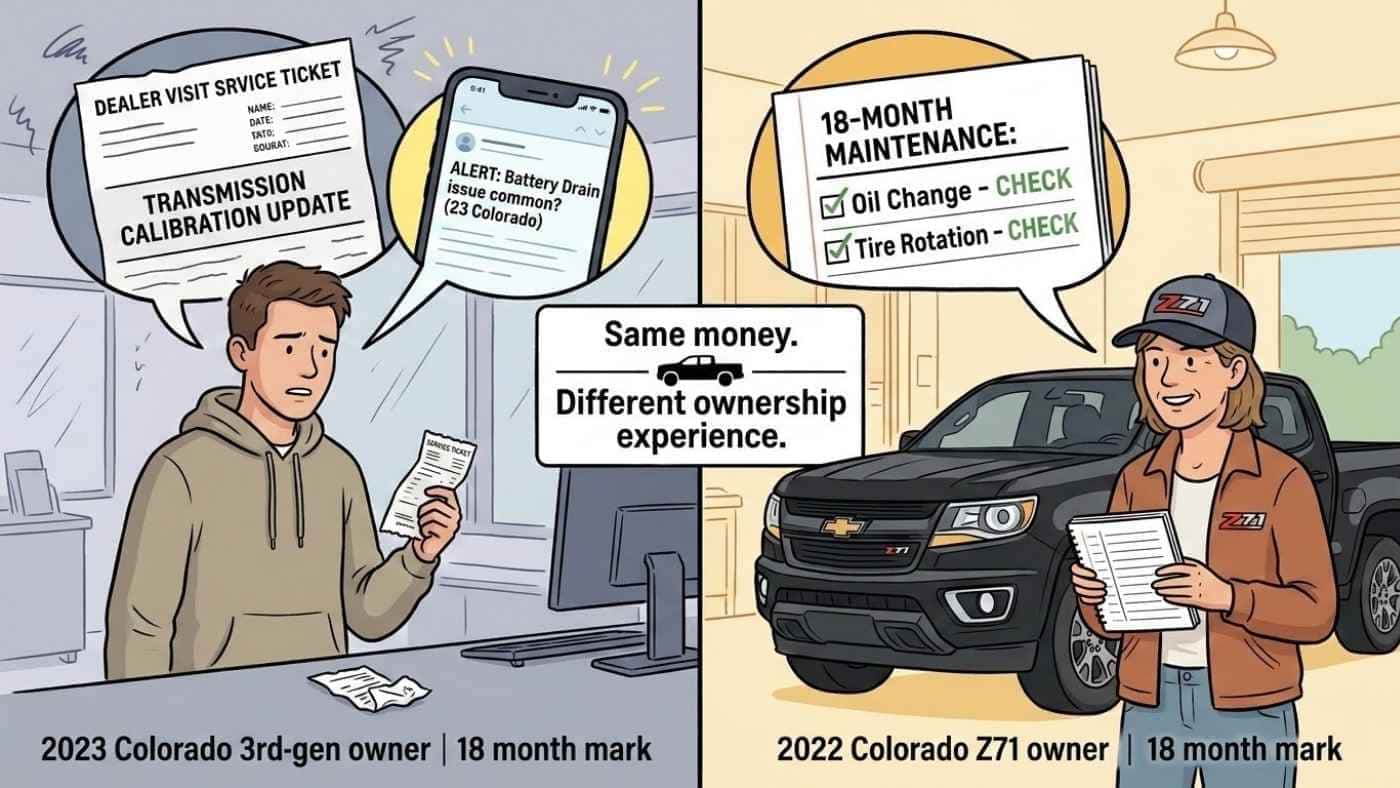
The 2nd-generation Colorado (2015-2022) has a complicated record. The 2015-2016 8-speed automatic hunting under load in the 3.6L V6 was a real and documented complaint. But from 2017 onward, with the transmission software resolved and the 2.8L Duramax diesel available as an option, the Colorado became genuinely reliable. The 2017-2018 Duramax diesel Colorado remains one of the best fuel-economy, reliability, and towing combinations in the midsize truck segment at any price point.
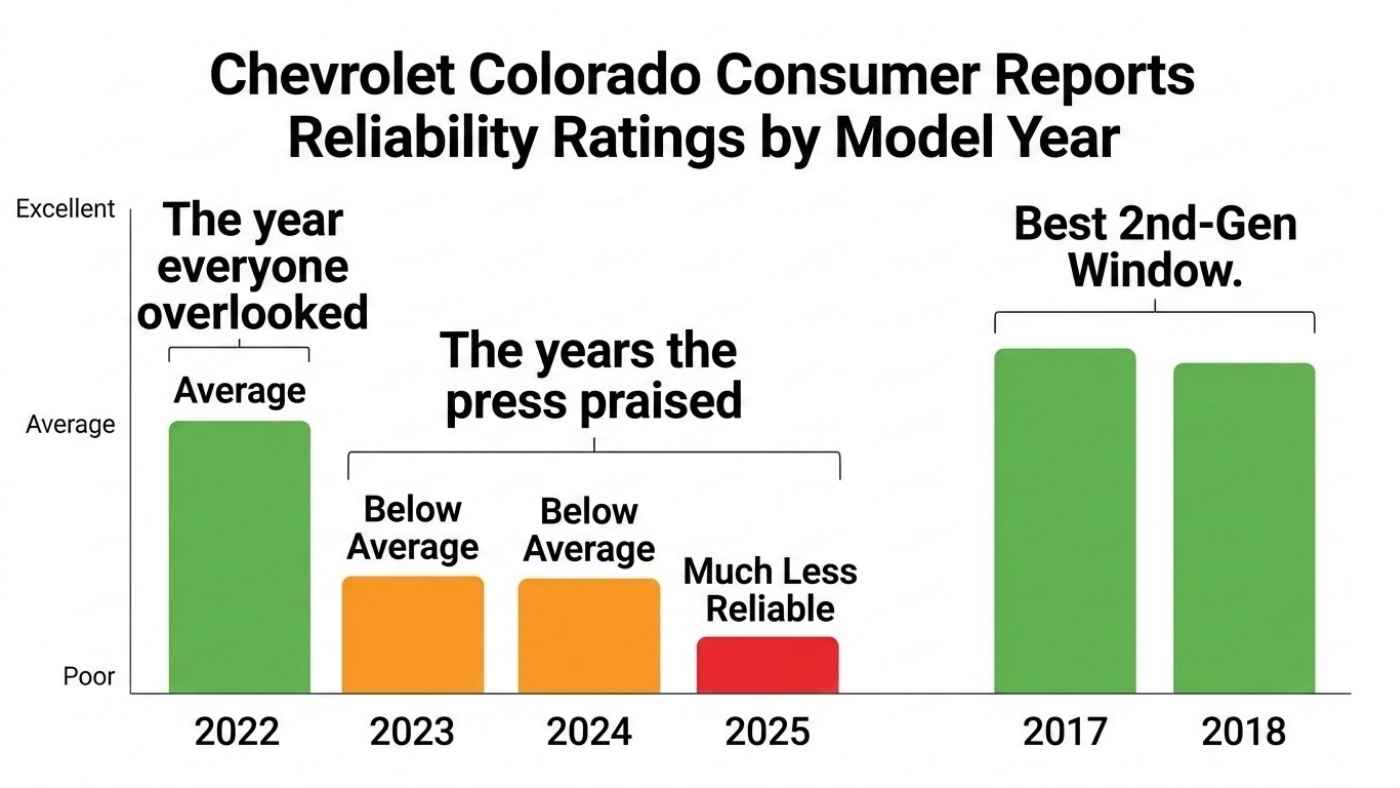
The 2022 Colorado, the last 2nd-gen year, scores average on Consumer Reports with only one NHTSA recall. Used 2022 Colorado LT or Z71 examples are available significantly below comparable 2023 3rd-gen pricing, with a reliability record the newer trucks have not matched. OEM-style Chevy Colorado seat covers are available for both 2nd and 3rd-gen configurations, and the seat dimensions differ enough between generations that confirming the year and trim before purchasing is essential.
| Year | Why It Stands Out | What to Watch at Purchase |
|---|---|---|
| 2017-2018 | Transmission fully resolved; Duramax diesel available; lowest 2nd-gen complaint rates | Confirm transmission fluid condition; check Duramax DPF maintenance history on diesel builds |
| 2019-2020 | Solid mid-generation builds; strong reliability data; widely available in used market | Standard pre-purchase inspection; fluid checks; bolster wear assessment |
| 2021-2022 | Production quality at peak; 2022 final year rates average on Consumer Reports with 1 recall | Run VIN recall check; inspect seat condition as mileage and use indicator |
Third-Gen Chevrolet Colorado: The Right Way to Buy One If You Want New
If you want a 3rd-gen Colorado, skip 2023-2024 and approach 2025 cautiously. The 2026 data is still thin. Buying new in the 3rd gen means accepting an extended warranty as near-mandatory, given the reliability ratings. Seat protection from the first week is the most direct action available on any 3rd-gen build. How seat covers protect 3rd-gen Colorado interiors through the 2.7L's documented idle and drivetrain patterns is the practical starting point for new 3rd-gen owners.
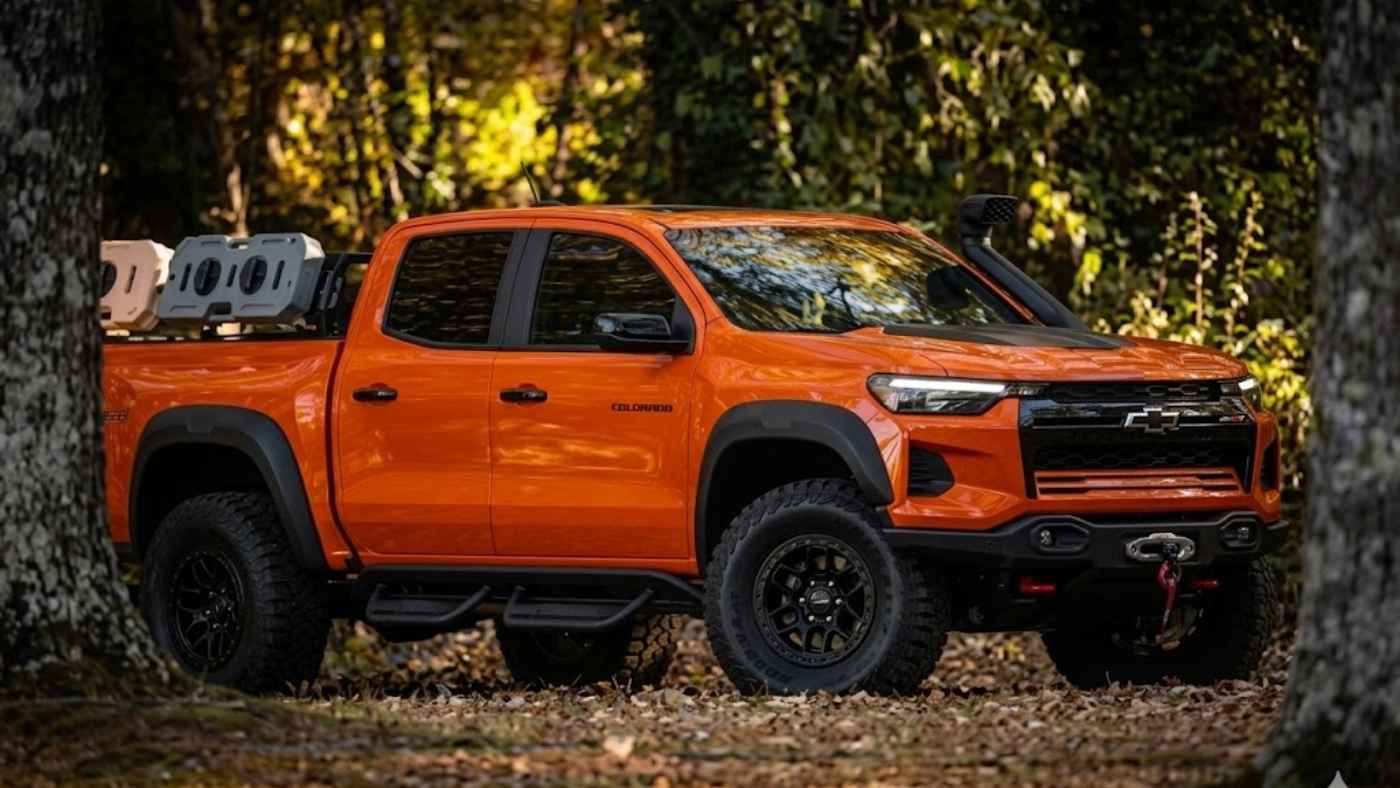
Chevy Colorado Seat Damage: What Actually Happens to These Interiors in Real Daily Use
Colorado owners skew toward outdoor recreation, weekend off-roading, and active daily use. The ZR2 and Trail Boss are popular with buyers who use them. The interior damage patterns reflect that: dog hair in rear cloth seats is the number-one owner complaint on Colorado fan forums, followed by UV fading on the driver seat in high-sun markets, and coffee and sunscreen staining on front cloth on daily-driven work trucks. The LT's cloth seats absorb spills within seconds. The Z71's leather-appointed seats develop cracking at the seat back on unprotected examples in Phoenix or Tucson within 18 months. Colorado-specific seat protection for outdoor and trail use addresses the specific interior contact patterns that ZR2 and Trail Boss owners report most.
One question Colorado owners ask frequently is whether eco-leather seat covers affect the Z71 and ZR2's heated seat performance in winter. The answer depends on material thickness. Seat Cover Solutions eco-leather seat covers are built thin enough to transmit heat without insulating the factory heating element. Seasonal seat cover guidance for Colorado owners in northern states is the most relevant reference for Trail Boss and Z71 owners who switch between summer trail use and Minnesota or Colorado winters.
The 2022 Chevy Colorado is the safest used buy in 2026, not the 2023 or 2024 that most comparison guides recommend. Average Consumer Reports reliability, one NHTSA recall, and used pricing below 3rd-gen examples make it the pragmatic choice. The 2017-2018 Duramax diesel build is the best long-term value in the entire Colorado nameplate. If you want a 3rd-gen, wait for more reliability data on the 2026 or accept an extended warranty as mandatory with a 2023-2025 purchase.
Frequently Asked Questions
Is the 2023 or 2024 Chevy Colorado reliable?
Consumer Reports rates both below average based on owner survey data. The 2023 model has complaints about rough idle, transmission hesitation, and starter failure. The 2024 model adds infotainment freezing and drivetrain issues.
What year Chevy Colorado is the most reliable?
The 2022 Colorado (final 2nd-gen year) rates average reliability on Consumer Reports with one NHTSA recall, making it more reliable than any 3rd-gen year. Among 2nd-gen builds, 2017-2018 represents the most reliable window. The 2017-2018 Duramax diesel specifically is one of the most reliable Colorado configurations ever built.
Is the 2.7L turbo in the 3rd-gen Colorado a problem engine?
Not definitively, but owner reports include rough cold-start idle, transmission hesitation addressed by software updates, carbon buildup concerns on the direct-injected cylinder head, and sporadic battery drain. None are catastrophic failures. All are documented patterns that suggest the engine needed more development time before production launch.
Is the Chevy Colorado ZR2 worth the price over a Trail Boss?
For genuine rock and trail performance, yes. The ZR2 adds Multimatic DSSV spool-valve shocks, front and rear locking differentials, and a more aggressive suspension tune over the Trail Boss's Z71 hardware. The price premium is roughly $12,000 to $15,000. For buyers who primarily drive on fire roads and gravel, the Trail Boss handles that use case at a significantly lower price.
What is the best seat cover material for a Colorado used for camping and trail?
Eco-leather. It is UV-resistant, wipes clean from trail debris and mud, resists sunscreen and chemical contact, and sheds pet hair from the seat surface. For Colorado owners who camp regularly, the ability to wipe a seat clean in 30 seconds after a trail run is the most practical seat cover advantage available.